
 I'm experimenting with the idea of an "adaptive syllabus" this year.
Fear not. I haven't removed the basic required course outline, but I've warned my students that things may shift and that they should be prepared to be adaptable. This isn't an experiment with their education but rather an investigation of how learning can be adapted when we embrace the unexpected (which always happens in classes but is rarely documented or monitored, from my experience).
Imagine a wall in a classroom where a student could make comments using a colored marker or post-it. Imagine weekly assignments getting shifted as needed. Imagine new ideas emerging because of real time experiences that a student or a teacher are curious to explore. If industry operates this way, shouldn't design education address it in some manner? If the design of things, ideas, products and software are meant to be agile, then shouldn't a design education promote the same model? Once you enter the daily reality of work, you find yourself getting interrupted for meetings, conference calls and site visits, which suggests another level of agility. The reality is, you have to shift. So I suppose I'm asking, "What if a course syllabus operated in the same manner?"
I don't profess to have a full grasp on this idea but I like the concept that a course outline has the potential for some interactivity and can mimic the realities of industry. I think it could be developed into a digital tool that would enable a student to interact with it before/during/after class (since I don't have a fixed space at ECU to allow for an analog interpretation, I'm hosting a one-sided test here). The image above simply highlights a framework but hardly represents the full experience of interactivity. Any interaction designers want to help me test the idea? #wink
I'm sure some instructors wouldn't enjoy this format so I'm hardly declaring it as the new way to develop a syllabus. But from watching the folks at the d.School and Hyper Island, I can see that there is definitely room for alternative methods of course development - and some that pursue interactivity at the same pace as industry.
Since this is a new concept for me, I'd love to hear your thoughts on this topic (whether you're a student, an instructor or an industry professional).
20 September 2010


15 September 2010

I've been crafting a list of tools as I consider how I might support individuals who are new to design. Since I'm teaching undergraduates this fall, this inquiry has become even more relevant. Many students are worried that they aren't taking the right path and fear that they might make a mistake in their education/career choices. Haven't we all? In my estimation, some of this stems from the temptation to compare oneself to another and assume that in order to be a good designer, I need to be like ______________.
In light of this, I reflected back on my own journey and asked myself how I got to the place I am today. Looking back, I can't underestimate the value of knowing the often overlooked skills that don't fit into a typical "list of tools." The reason? They are unique to each individual! While I am a proponent of developing and nurturing one's craft, there is also great value in actually knowing and identifying your strengths.
In the words of Socrates: Know thyself.
Some might classify these as "soft skills" but I would suggest they are fundamental to developing your toolkit. And since design operates as a collaborative discipline, understanding strengths can help build strong and effective teams.
I went back to some notes and readings from my own search and came across a few tools that have helped me frame these "soft skills" for myself and others. They may be obvious options but in re-reading them, I was encouraged by the direction my work/life/career has taken.
1. StrengthsFinder
StrengthsFinder proposes that we should reduce the amount of time we spend worrying about what we aren't good at and instead nurture what already comes naturally. Here are my top 5 strengths discovered in this process:
a) Ideation
People who are especially talented in the Ideation theme are fascinated by ideas. They are able to find connections between seemingly disparate phenomena.
b) Connectedness
People who are especially talented in the Connectedness theme have faith in the links between all things. They believe there are few coincidences and that almost every event has a reason.
c) Strategic
People who are especially talented in the Strategic theme create alternative ways to proceed. Faced with any given scenario, they can quickly spot the relevant patterns and issues.
d) Input
People who are especially talented in the Input theme have a craving to know more. Often they like to collect and archive all kinds of information.
e) Intellection
People who are especially talented in the Intellection theme are characterized by their intellectual activity. They are introspective and appreciate intellectual discussions.
2. Myers-Briggs
We've likely all taken this test! Here's a brief breakdown of my INTJ-ness:
With Introverted Intuition dominating their personality, INTJs focus their energy on observing the world, and generating ideas and possibilities. Their mind constantly gathers information and makes associations about it. They are tremendously insightful and usually are very quick to understand new ideas. However, their primary interest is not understanding a concept, but rather applying that concept in a useful way.
In education they are most often found at the college and university level. In the professions, they may be a lawyer, a business analyst, or strategic planner. Some have a strong artistic/creative bent and may become an artist, inventor, or designer. Whatever they do, they do it with intensity.
Final Note: There are many other tools one could draw upon! These are but two that have offered me some language to articulate skills that might be missed in talking about a "toolkit" (and were actually assessed more than 10 years ago). I believe that this type inquiry serves to help a designer acquire the most important tool in these times: a unique voice that will speak to the complexities of our world through the discipline of design.
Photo credit: Martin Whitmore
06 September 2010
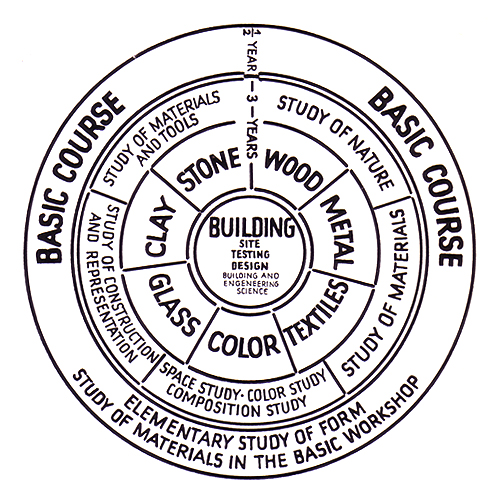
As I continue to prepare for my teaching roles this fall, I'm drawn back to my own experiences of learning design. I recall focusing one investigation on the Bauhaus as I was drawn to its obvious articulation of curriculum and pedagogy (the diagram above provides a visualized overview of this).
When you consider all that you've learned, what do you think young designers should know in order to be equipped for these times? If we look at the model of the Bauhaus, what should a one year "basic course" entail in 2010? If you could go back to school this fall, what would you focus on or improve?
Update: I just finished reviewing Johannes Itten's book and came across this detail that is worth mentioning if we are to consider what could be adapted for a basic course in this day and age. Since he was tasked with setting up the Basic Course, his three aims are valuable insights into this dialogue:
1. To free the creative powers and thereby the art talents of the students. Their own experiences and perceptions were to lead to genuine work. The students were to free themselves gradually from dead conventions and to take courage for work of their own.
2. To make the students' choice of career easier. Here the exercises with materials and textures proved a valuable aid. In a short time each student found out which materials appealed most to him; whether wood, metal, glass stone, clay or yarn best stimulated him to creative activity. Unfortunately, at that time we lacked a workshop for the Basic Course in which all fundamental skills, such as planing, filing, sawing, bending, glueing, and soldering, could be practiced.
3. To convey to the students the fundamental principles of design for their future careers. The laws of form and color opened the objective world to the students. In the course of the work the objective and subjective problems of form and color were integrated in so many ways.
Notably, he also started each class by including exercises to prepare the students physically and mentally (relaxing, breathing and concentrating): "The training of the body as an instrument of the mind is of the greatest importance for the creative man."
02 September 2010
In the spirit of working through a list of questions before we design, I thought this inquiry might also prove beneficial. If we want to design for people outside of our context and culture, should we be asking these types of questions? What would a design outcome look like if we investigated even one of these differences in our design process?
66 Ways We Differ:
1. How we define "proper" behavior
2. How and when we greet each other
3. What's considered common courtesy
4. What's polite or impolite
5. How closely we stand to each other
6. The holidays we celebrate and how we celebrate them
7. How we show respect and disrespect
8. How and why we use money, credit and bartering
9. The range in which we negotiate
10. What is modest or risqué
11. What is embarrassing or shameful
12. What makes us feel good, and what depresses us
13. What makes us proud and what shames us
14. What, when and how we eat and drink
15. What we wear, and when and where we wear it
16. How we see and behave toward sickness and health
17. How and when we seek and use health services
18. What we find funny or sad
19. How and when we use means of transportation
20. What we buy and sell, and when, how and with whom we do it
21. When, where and how we sit and stand
22. If, how and when we touch each other
23. What we believe
24. What we value
25. What makes "common sense"
26. What are worthwhile goals in life
27. What is beautiful or ugly
28. The nature of God and other religious beliefs
29. What we believe we need and don't need
30. Whether privacy is desirable or undesirable
31. Who makes decisions and in what circumstances
32. Whether a person is in control of his or her own life and whether fate determines it
33. What should be communicated directly or indirectly
34. What or who is clean or dirty
35. What language, dialect and tone of voice we use
36. To whom we speak and to whom we do not speak
37. The role of the individual
38. The roles of men and women and how they should each behave
39. The roles of parents and children and how they should each behave
40. The importance of harmony in a group
41. The importance of competition between individuals
42. Social class
43. Educational levels
44. Hierarchy in business relationships
45. How time is understood
46. Whether schedules are important or unimportant
47. The importance of tradition and rituals
48. How often we smile, who we smile at and what it means when we smile
49. How strangers interact
50. How we interact with a person in authority
51. How we interact with a person serving (e.g. in a restaurant)
52. Relationships and obligations between friends
53. Relationships and obligations toward extended family and relatives
54. Facial expressions and other nonverbal behavior and gestures and when they are used
55. Crowd or audience behaviors
56. The importance of preparing for the future
57. How we see old age and how we value elders
58. Whether conversation should be formal or informal
59. What should be said and what should be left unsaid
60. Whether, when, how and with whom we make "small talk"
61. How we perceive what is friendly or unfriendly
62. How open or guarded we are with information
63. What behavior is ethical and what behavior is not ethical
64. How, whom and how much we entertain
65. How or whether we take turns, stand in line, etc.
66. How often we change jobs or move house and where and why
Source: Global Competence: 50 Training Activities for Succeeding in International Business, Jonamay Lambert, Selma Myers and George Simons, Editors, Amherst, Mass: HRD Press, 2000.
26 August 2010

We all get asked about what we do. Sometimes we get asked how we arrived at the place where we really knew what we wanted to do (a common inquiry from my students). This less than ideal image represents a moment when I began to get a feel for how I might answer this question.
Please note: I wasn't fresh out of high school and I hadn't just received my undergraduate degree. If I'm totally honest, I was feeling pretty discouraged and wanted to find a way to see the world differently. The camera forced me to do this by virtue of putting the world into a frame.
This moment helped me to identify one thing I really like to do:
Observe.
I now call myself a design researcher* (for the sake of identification) but if I distill this notion down, it comes back to being someone who observes and investigates. These observations can take various forms: people, places, systems or experiences. I use these observations to help me design things more effectively and/or appropriately.
It is one thing to talk about what you do. But in my own career journey, I've also been interested to know how someone actually does what they do. In light of my pursuit of this path, I have been developing a "toolkit" that I can draw from in order to do this observing well. So I figured it might be valuable to document the tools/resources that I use when I do what I do. I'll write more in the coming weeks about items or ideas I have found useful.
#1. CAMERA
Since I opened this post talking about cameras, it seems an obvious tool with which to start. I currently use a DSLR and an iPhone (but as you can see from the above image, have also used a point and shoot). A higher quality video option is next on my list of acquisitions so if you have any recommendations, let me know. Flickr is one place where I can store/share these observations (but I give the disclaimer that if you are working on observing for a client, you'll want to ensure you've considered things like informed consent when it comes to showing your imagery).
I've also considered how I can allow others to be the observers of their own experiences. In this case, I've used a single use film or point and shoot digital camera to enable others to participate in the research. I've done this so I can actually get out of the way (because being an observer doesn't always equate to being invisible and sometimes, this can actually be a distraction).
Which kind of camera should you acquire? From my experience, this will depend on the context you find yourself in. If you're a travelling researcher, you may need to factor in easy of use and weight considerations. If you're researching on a topic that requires something more elaborate, you may find yourself with a more significant set of gear.
More to come.
---
*IDEO provides a definition of how they interpret this role which resonates with me:
"Design Researchers lead teams through inspiration-gathering and people-understanding experiences to uncover stories and insights that help guide design and innovation. In addition to being empathetic, creative, and strategic, here are some of the qualities we’re searching for:
Passionately curious – People who are excited to be in the field and as inquisitive about other people and their stories as they are empathetic.
Captivatingly articulate – Compelling storytellers who can get people out of their seats and bring tears to their eyes.
Provocatively thoughtful – People who can challenge conventions and inspire teams and clients to translate keen observations into compelling ideas.
Sensorially inspired – People who are inspired by emotions and engaged in all of the senses."
10 August 2010

The UBC students I worked with this summer finished off their project by recalling the ideas we considered at the start of our time in Rwanda. The top image is the word they would use to describe their feelings at the end and the bottom image shows what they felt when they first arrived. Love this!

(Top photos courtesy of the students and bottom photos were taken by me)
04 August 2010

I'm thrilled to see (and participate in) the launch of openIDEO as it reinforces the concepts covered in the Design For Social Change course and pursues similar ideas that were developed when creating Dinner With A Side of Design. From inspiration to evaluation, diverse groups can collaborate together on tough challenges with the aim of actually participating in the process of solving the posed problems. I am keen to see how it will develop and grow over time and am encouraged to see a platform that doesn't just talk about the big issues facing us but also provides the means to tangibly respond with our collective insights.
29 July 2010


Six weeks ago, a group of diverse students gathered for the inaugural course of Design For Social Change at Emily Carr University.
In this short amount of time, they covered themes ranging from human-centered design principles to viable economic concepts that help actual change to be realized. The course was intensive but they worked very hard to produce interesting concepts that could be further developed for actual implementation. One group has already begun working with two organizations in Rwanda to enable their concept to be developed and tested there. Another group is going to push their idea by allowing a few families to test their "new vision of hosting in smaller spaces" table (see above image).
Some of the aims of this course are to teach:
Research skills
Collaboration skills
Creative/design process
How to engage creativity in complexity
Critical thinking
Understanding who you are designing for
How to develop real deliverables for your users
Visualization and articulation of ideas
The intensive nature can be challenging but I think I can say that all students (while still mulling over all they've had to ingest) will tell you that the opportunity to apply theory made a difference to their learning experience.
It was an absolute delight to both learn from and teach this crew and as per usual, I am challenged to continue considering what role design can play in influencing the type of change that is worth adopting.
A recap of our weekly engagements:
Week One
Week Two
Week Three
Week Four
Week Five
Week Six (we even had a design dinner to start the class!)
This course will be offered again in Fall 2010.
PS. If these kids can do it, so can we!
23 July 2010

The results are in! I just got word that of the 413 households surveyed, this was by far the most popular concept (of the options presented) for packaging a micronutrient. This isn't going to be the actual packaging but was a way of doing formative research to find out what the preferences of a rural woman might be when it came to visualizing the idea of adopting the behaviour of adding a micronutrient to a child's food. The reasons for its popularity seem to relate to:
a) Color (these are the colors of the Rwandan flag)
b) Image (the action of feeding the child makes it clear as to what to do with the contents)
There is more work to be done and we're awaiting the opportunity to see it be pilot tested and developed further. But this was exciting news for sure!
21 July 2010

I am so proud of the crew of students I've gotten to work with in this class! We have one week left, which means the process and thinking they've engaged in this short amount of time is impressive.
Tonight we discussed their prototypes and gave feedback for further development. We also covered what it means to deliver your final outcome. Here are some good questions to ask (sourced from the HCD Toolkit) in the process:
Where, when, how and why might the customer experience our solution?
What channels can assist with distributing our solution?
What are the range of ways it could be delivered?
What human, financial, manufacturing or technological elements are needed?
Who could we partner with to show the value and impact of the solution?
How will we test our idea?
How will we implement the idea?
What will be our measure of success?
How will we generate feedback?
Links:
The Ripple Effect
Dining Room Made of Pop Bottles
Karaoke and Literacy
Better World By Design Challenge
$100 Ventilator
For our last class, we're going to eat together before presenting the final projects. I'm excited to see their final outcomes! And in case you're wondering, here's what's on the menu:

14 July 2010
Design For Social Change: Class Four


After sharing the outcomes from preliminary research, we got onto the topic of social change and its relationship to economics. Each group has been encouraged to assess their concept by asking if it can be sustained over time. The Human Centered Design Toolkit has a great handout that articulates ways to assess whether you have a sustainable revenue model so I shared this as an accessible tool for evaluation. It suggests that we have a value proposition, an identified revenue source and stakeholder incentives.
Afterward, each group was asked to ideate possible solutions for their social change project. There was definitely laughter, which suggests that some wild ideas are emerging!

Next week: Prototypes.
Random recommended links and/or topics discussed:
Echoing Green
Jamie Oliver's Food Revolution (and follow up)
Genius of Design
Blue Vinyl
Unicef Kits
13 July 2010

I've been contacted by a grad student who has asked me (and other designers) to talk about our design process as part of her thesis research. More to the point, she wants to know how our processes differ when working cross-culturally. Because of her inquiry (and all the dialogue going on around humanitarian design these days), I've been hammering out some visualizations for her.
As I began to draw my process, I was reminded of a diagram I created during my own research. It arose while reading an article where Gui Bonsipe was interviewed. He points out a dichotomy that can impact design: there is a difference between the centre and the periphery. The simple sketch (above) was a way to visualize how my design process required that I understand the political structure in which it resides. In the case of my recent project in Rwanda, I spent a fair amount of time meeting with stakeholders within the Ministry of Health. All this before putting a pen to paper! Take a look at the layers that the MOH are collaborating with on various projects. We didn't meet with all of them but had discussions with at least 50%:

So as I continue to create a diagram for this student, I am forced to assess how this complexity fits into the design process. The centre (often representing governments and authorities) may not be aware of the periphery (non-profits, field workers, communities) at any given time. To only target periphery projects may miss important aspects as they relate to systems and infrastructure, which will be necessary to understand if one wants to make a lasting impact. In my case, the design solution could affect over one million people, which requires an adjustment in my thinking and research when it came to engaging my overall process. In order to see this project be implemented, I will need to work with both the centre and the periphery and find ways to address both similarities and differences. I think I take this part of the process for granted in my own context but then again, I've not had the chance to work on something for one million Canadians. Yet.
09 July 2010

It's amazing to me. I'm a designer and yet I find myself in a sketching rut these days. My graduate research even focused on the ideas of visualization as a communication tool. So when I saw this project, I figured I'd found a creative way to face it head on. If you're groove-challenged of late, consider joining me!

08 July 2010
For The Love Of Labels

Bruce Nussbaum wrote an article (which I would recommend you read before you finish reading this) that begs the question: "Is humanitarian design the new imperialism?" With a provocative title like that, it begs discussion, yes? And I think it is a good one to have.
Advance apologies: This is longer than expected. I hold the complexity of the content directly responsible.
As someone who has been offered the privilege of working alongside individuals in another culture during my graduate work and beyond, I can appreciate the complexity that this question raises. During grad school, I was called a "design interloper" for choosing to focus my attention on a country other than my own. This label presumes many things, one of which is the notion that I might create something that lacked care or thought. I realize there is a history of such outcomes (which is not exclusive to the profession of design) but I struggle to classify every approach listed in the article as imperialistic. To suggest that designers might be "the new anthropologists or missionaries, come to poke into village life, "understand" it and make it better" seems to oversimplify this discussion and adds to a slew of words that keep us from understanding the layers that are involved in a very complex topic.
During my experiences in Rwanda (which for the record is not representative of the entire continent of Africa), I found myself faced with design questions on a daily basis. Since I am always evaluating how design as a problem-solving discipline can provide a solution, this can become heightened when witnessing significant issues that affect 90% of the world's population. After spending 3 months with a group of women who were unable to get ahead financially because of issues that actually could be addressed, I had a dilemma on my hands:
Do I give them money? This could be a merciful act.
Do I nod apologetically but walk away for fear of imposing my ideas? This might reduce the label issue but poses other problems.
Or does design have a role to play? Would it be a just act to actually improve the situation? If we worked together, could we collectively address this?
Don't get me wrong. There is no formula. But somehow the last option, when handled with care and attention, offers me something beyond a label. And is therefore more costly and complicated.
By definition, design is a discipline that inserts itself into our world where it may or may not be welcomed. Development as a field of work also has a history of inserting itself where it may not be needed. Put these things together and you have increased complexity. And the potential for increased labels. But this is not a new thing in design. Gui Bonsiepe has worked in other countries for many years and writes about the role that design can play in a given culture. This is a long quote but one I believe summarizes the sentiment well:
Design humanism is the exercise of design activities in order to interpret the needs of social groups, and to develop viable emancipative proposals in the form of material and semiotic artifacts. Why emancipative? Because humanism implies the reduction of domination. In the field of design, it also means to focus on the excluded, the discriminated, and economically less favored groups (as they are called in economist jargon), which amounts to the majority of the population of this planet. I want to make it clear that I don’t propagate a universalistic attitude according to the pattern of design for the world. Also, I don’t believe that this claim should be interpreted as the expression of a naive idealism, supposedly out of touch with reality. On the contrary, each profession should face this uncomfortable question, not only the profession of designers. It would be an error to take this claim as the expression of a normative request of how a designer —exposed to the pressure of the market and the antinomies between reality and what could be reality— should act today. The intention is more modest, that is to foster a critical consciousness when facing the enormous imbalance between the centers of power and the people submitted to these powers, because the imbalance is deeply undemocratic insofar as it negates participation. It treats human beings as mere instances in the process of objectivization (Verdinglichung) and commodification.
In light of the many directions I could go (and this post is already way too long), I'll focus on three things I've been thinking about lately as they relate to this discussion:
Labels can lessen impact and cause more confusion: The label of "humanitarian design" doesn't cover the range of work being done in other parts of the world. And you would never show up in a country and announce, "I am a humanitarian designer" when describing the work you are about to do. I would go so far as to suggest that ProjectH, Acumen, Idiom and IDEO are not all doing humanitarian design even though they have been seemingly classified as such in this article (as per the noun/adjective distinction). This isn't to say they aren't all exercising compassion in their approach but I would imagine would make distinctions about their focus. Suffice it to say, I'm slowly learning to tread carefully when assigning titles. They make for a great 30-second story but can be misleading and limiting (see David Sherwin's post on Bingo For Social Innovation).
Time is a valuable commodity that can often lack funding: Designing from a distance using online research is futile. Spending two weeks in a country will often lead to premature assumptions that will affect design outcomes. This means you need to spend significant time where you design. The more you observe and participate in a culture, the better you can assess whether the design outcome will be beneficial and sustainable. Becoming informed about all these layers (economic, environmental, political, social, cultural...) will help reduce the potential for inappropriate or misguided design. Ideally, we'd be doing this in our respective cultures. Naussbaum rightly points out that we can learn from others in this globalized reality we find ourselves in. When we understand how design impacts other cultures and communities, we can ensure we do right by our designs. To do this, exchanges of ideas and information could help us design in our context. Unfortunately, many design projects that fall into this camp tend to rely on grants or donations in order to be implemented. And this can affect the amount of time required to do research and design testing. And so the cycle continues...
Design education could offer people the skills needed to allow for localized solutions: My recent visit to Rwanda to work on a project revealed that many university students would love the chance to study design (which is not currently offered in any of the schools there). I hope to participate in some way to offer courses that could allow this aspiration to be realized in the future (and had some good discussions as to where this might fit during my last trip). Because there are limited budgets for such an endeavor, design projects continue to include designers from other parts of the world. I would love to find a company that could help fund the development of an education program for a local university that may want design but not yet have the resources to make it happen. I have a lot of respect for the work of Professor Ranjan at NID in India. I envision the same for my Rwandan friends who want to make an impact in their villages through design.

(Image sourced from Design For India Blog)
Addendum: Emily Pilloton's great rebuttal!
07 July 2010


We're on week three of the Design for Social Change course and we started the class with a brief discussion about "sustainability" as it relates to our design considerations. As you can see from the images above, the interpretations are varied (a visual reminder of how broad and complex this can be!).
Links that were presented in class (but in no way exhaust the topic):
Cradle to Cradle
Biomimicry
Ask Nature
Okala Guide
Designer's Atlas of Sustainability
Objectified Film
78 Questions
Worldchanging
Bonus material (or stuff we didn't have time to cover):
Story of Stuff
The Living Principles
The Natural Step
The Power of Time Off
We're at the halfway point of this intensive course and I am looking forward to seeing the concepts that will emerge from the research process!
30 June 2010
As promised, I post an overview of our weekly class so that students can have a list of links and information about topics covered. Last night, we discussed the role of human-centered research as it relates to social impact projects. I think that all the students will confess that the hardest part of this process is finding out what are the right questions to ask in order to map out your research plan.
Because of this, I invited a graduate of Emily Carr to present her research as a case study of how the process can unfold in order to develop a deliverable. It is one example of how a designer can approach the research process. There are obviously many more!
We also touched (very briefly) on the importance of ethics in the process of research. This is a large topic but we discussed how we can ensure that our participants are made aware of what their involvement entails.
Three groups have formed and are focusing their projects on a topic of their choosing. They have opted for Living/Dwelling, Education and Aging. Each group has been working to refine the problem they want to tackle in each given area so as to develop a research plan. These are some links we looked at in order to frame the next phase of their projects:
Human-Centered Design Toolkit
Ethnography Primer
Raneen Nosh, Designer
IDEO Method Cards
Design Council RED
Participle
Sam & Dave Save The World
Sample of Informed Consent Document
And this is a great link that considers the brainstorming process (in business or social change projects!): Better Ideas Faster
If other educators or designers have links to share, I'm sure the students would be grateful.
22 June 2010


Design For Social Change started tonight and I'm delighted to report that I get to work with a great crop of students! We agreed that I could post outcomes and links that resulted during each week so as to chronicle this inaugural course.
The images above represent the start of their "actionable problem statements" that were developed after everyone expressed areas they would like to see design contribute to when approached as a conduit for "social change." Main objective? Focus on change as opposed to awareness. Here are some of the links/case studies we explored or discussed during this class:
Tim Brown's TED Talk
Curitiba's Transportation System
Target ClearRx
Zipcar
Deep Dive
Kiva
Index: Award
Design Revolution
Do Good Design
Designer's Atlas of Sustainability
A highlight for me? Many see this as a portfolio building opportunity because of the type of approach and research it requires. Yay!
15 June 2010
Can a logo change the world?
Well, this one certainly has, hasn't it?
As I prepare to head to Seattle to participate in this event, I continue to reflect on the role of design in a place like Rwanda. Designing a logo with the women of the weaving cooperative is a reminder that sometimes the little things become the conduit for potential bigger things. When I visited the women last month, they were preparing products for a trade fair in Kigali. To see that they could now have their own brand identity to represent the work among many others gave me hope that design will continue to play a role in their community and future. How that happens is yet to be fully realized but as a consumer of their products, this identity mark does offer additional value to the product as it sits on a shelf.
We know that logos are a language that have the power to help or hinder in our world. While the logo is seemingly a reflection of the company or organization's actions, it is also the visual mark that everyone will remember (or easily forget). To me, it's like naming one's child - with this act, you project or claim a hopeful future. Following that logic, I wouldn't suggest that naming and identity alone can ensure anything. It's how and what you deliver in the end that ensures this identity continues to hold value. For these women, I hope they can increase their product offerings in the future to ensure a distinct market, which the logo has only begun to establish. And in their case, this distinction could change their world by moving them from a wage of $1-2/day to $15-20/day.
These images reflect the co-design process - from concept drawings to a final stamp.


05 June 2010
A Recap of Rwanda
I had anticipated having more time to write about my design work while in Rwanda. Since the fiber optics continue to be placed in the ground, the bandwidth is not yet at the capacity required for effective photo and video uploading. So here's a few tidbits that I wanted to share now that I'm home. These vignettes capture some of my design encounters as I spent time in various parts of the country over the past month.
1. Coffee Processing Tour

During my visit to this plant, I learned about the life cycle of the coffee bean. Notably, beans that are not usable for the highest quality roasting are not discarded. Instead, companies like Nescafé take them on for their coffee purposes.
2. Spaces for Ideas Book

I came across Brian Ling's books before I left and wanted to take some along with me. They arrived in time and I used them to continue my Kinyarwanda language development. During my last trip, I started a book using a Moleskine and it served as an amazing tool to connect with rural communities where language could have been an obstacle to understanding. Since communication designers need to understand language, continuing this exercise has been helpful in my process.
3. Critiquing Design for a National Brand

While working in Rwanda, the Director General of Rwanda's Horticulture Development Authority asked for feedback about logo design for the new horticulture brand being developed for the country.
So I asked the students from UBC and Inatek to vote based on color, logomark, typography and naming. We're not yet sure of the final outcome (and I wish I could show you the options) but this was truly a great experience for me as a designer in another culture!
4. Paper Prototypes

We had the chance to visit a vocational training school where some of the students are learning how to sew. This pattern is made of paper and stitched using a machine. And while it is meant to show the quality of a sleeve and how to create one, I find myself wanting this framed in my home! It was an absolute delight to see and feel this prototype.
5. A Young Man Designs His Home
Meeting Charles was a highlight. While I could tell you of his story of survival as a 9 year old boy during 1994, what I feel is more important is to hear about his perspective on building his home. My favorite bit in this clip? He feels his home is finally finished (while we might imagine alternate improvements or adaptations).
6. Revisiting the Research


Getting to return to Gashora and visit the cooperative of weavers was a definite highlight for me (if you are new to my blog, here's some information about my work there). While we couldn't communicate on all topics, I did ask why no one picked the money image that was included as an aspiration card in my research. They answered that it wasn't a picture of something they understood. Fair enough! I was delighted to see that they were still using the logo stamp and when I purchased a basket from them, they were sure to attach a label onto it for me. Being able to show them how their design ideas were being shared with thousands of people was likely more invigorating to me than them but it was great to be able to let them in on the ways that their work was influencing others.
Now what?
I'm now back on North American soil but am looking forward to what the next steps will hold with this project. Specifically, I am excited to develop a proposal for a national initiative that will provide affordable micronutrients to children. My focus will continue to be on the packaging and distribution messages). In talking with key leaders and influencers, I'm hopeful that this project will get developed and funded sooner rather than later. Beyond this, I'll be working on workshop and curriculum proposals so that on my next trip I can begin to teach design courses to Rwandan students (and plan to use the Spaces For Ideas books as a design journal!).
The full photo set on Flickr
Videos on YouTube
18 May 2010
 As I work on packaging ideas for the micronutrient supplement, I have gained some insight that pictures would be preferred over illustrations. And so I need an image of an African baby (eating food preferably) but many stock photography companies are showing a very African American perspective, which is clearly not the same reality for a rural Rwandan woman.
In my own context, I would likely hire someone for this but finding and sourcing this type of imagery (that would be relevant to this context) becomes a bit more tricky. I can't imagine asking a women here if she would like to have her child placed on every package that would be sent out. Perhaps I need to be more open (and am aiming to meet up with a local designer I've located to gain more insight into this aspect of the design process).
During all my searching, I came across this brilliant Zambian stamp from the 1970s and I found it ironic that it was actually promoting nutrition. Now if only I had this kind of drawing skill!
14 May 2010
What word comes to your mind when you think of Rwanda? For many, in light of its past, "genocide" can often be the default. But after you arrive, you can't help but be reminded that this nation holds a new and invigorating story.
Six UBC students are here working on research related to improved nutrition in Kibungo (with a program called Go Global). They are each paired up with two INATEK students so as to develop and implement a survey that will be administered to 500 households. No small feat! Their research and findings will help inform what I design.
I asked them to write down the first word that came to their mind when they thought of Rwanda at this point of their trip. This is what they came up with (and we'll do it again at the end to see what else they come up with).
L-R Top: Roberta, Kaylen, Melissa
L-R Bottom: Sharon, Gurjeet, Sung Kyu
10 May 2010
I met a designer today.
His name is Juma.
He got his training in Belgium as a graphic designer and now works primarily in the Rwanda Health Communications Centre. We both agreed that including some design training into the curriculum here would be beneficial. Apparently, there is a communications department at the National University that could be a good start. He figures he could learn something from me. I told him I imagined I could likely learn more from him.

Printing at Rwanda Health Communications Centre
My meeting with their key spokesperson, Nathan, yielded some interesting insights and information that will help me in planning for any design concepts in our project:
1) Community Health Workers (CHWs) are the people who will have the most impact in transmitting information (even someone from Kigali will be less likely to affect any type of behaviour change or product adoption)
2) The president has just initiated a program that will provide all CHW’s with mobile phones
3) There has yet to be a national campaign focused on nutrition (as other priorities take up the majority of their efforts)
4) People continue to be interested in the relationship between agriculture and nutrition (and how that actually gets measured and monitored)
5) T-shirts and umbrellas that have been used as incentives aren’t necessarily the most long lasting tools so research into what works best for health initiatives will be helpful
6) There are no extra copies of the CHW tools created on file since all of them are already in the field
7) Infant and young children nutrition tools (image below) are apparently developed but are still in the “soft copy” stage (which will help me understand how to work alongside what has already been developed)
I also asked Nathan about the types of visuals that have been successful in other campaigns. It was great to show him the various Sprinkles packaging concepts that have been developed and have him offer suggestions of which ones he felt would be adopted most quickly. Obviously, I’ll set out to design a variety of options to see which will be adopted or preferred.
For me, this was a key meeting and their department is keen to be in touch about the progress and process of our work as some of the information they want takes time to receive in order to message things in a timely manner. I love cross-disciplinary, cross-cultural collaboration. It isn’t a rapid process but offers relevant insight and potential.
Image developed by J&J Top Graphics Designers in Kigali, Rwanda
07 May 2010

So I find myself back in Rwanda as a designer, observer, learner, muzungu, and traveler. It is all at once familiar and foreign. And all so very good. I am learning much because as per usual, I am working on something that hosts a steep learning curve. Here is the essence:
I am collaborating with a professor of international nutrition from UBC and we are here investigating various opportunities to see if they can be applied as appropriate and effective interventions for the future. The aims of the project are multifaceted. In order to address this complexity, we are meeting with key stakeholders and leaders, such as the Minister of Health, the Director General of the Rwanda Horticulture Development Authority, Rwanda Agricultural Research Institute and various others in the Ministry of Agriculture. There are more meetings to come! We are also set to meet with individuals from nutrition and health communications. We do this to ensure that we contribute to the tools already developed and complement, rather than contradict their efforts.
In the simplest terms, we are looking at the relationship between agricultural improvement/growth and nutritional impact in rural communities.
As the designer on the team, I am aiming to understand health messaging: how to do it appropriately and effectively with the ultimate goal of developing tools for behavior change and adoption in this diverse and cross-cultural context.
One of the focuses of my work will be to consider how I can apply the HCD Toolkit and related methods by adapting it to suit some of the quantitative approaches used by my colleagues. I am looking forward to sharing these ideas with those outside the field of design and seeing how they can be used to assess the community needs and aspirations (while also providing a framework for successful implementation). I am also keen to learn about their methods in order to ensure a robust and valid outcome that can be measured in their respective disciplines.
Using these methods and approaches, I am aiming to develop solutions for messaging a micronutrient to the mothers of infants/young children aged 6 mos – 2 years (who are not included in typical targets when addressing malnutrition). This messaging will run the gamut: from packaging and promotion to distribution and impact assessment (as the framework for a home-based food fortification program). From here, we are also considering how to incorporate a larger integrated approach into the current approaches to agricultural growth and nutrition impact evaluation. We’re in the formative stages but are excited about the potential (and enthusiasm from those we’ve encountered so far).
Of note is the response I get when I say, “I’m a designer.” The Minister was surprised that an art and design school could exist in an exclusive institution. The head of the research institute wanted to put me to work in their office immediately! These responses are notable because there are no design schools in Rwanda (and yet everyone acknowledges and appreciates the value of communication). Because of this, I look forward to the day I might find myself teaching courses to Rwandans that will enable them to develop these tools and messages. And as a result, I get to learn much from them when it comes to designing outside one's own borders.