
23 March 2009


18 March 2009
Good Design

Frequently, designers are not given to thinking about the premises on which their arguments are based, but in a world where every design is connected to a sprawling set of decisions and consequences, they should be. Viewing designs as arguments frees us from the art world's tendency to evaluate on aesthetic criteria alone. It insists on contextual evaluation: design is not just about how a thing looks or how it works; it is also about the assumptions on which it rests.
---
But the most valuable effect of considering an object as an argument is that it allows us to look under the rhetorical hood and consider it not as an inevitable or neutral invention but as something that embodies a point of view.
Peter Hall
Metropolis Magazine
March 2009

Sidebar: Project M (people on my page)
06 March 2009
Design for Democracy
Last night, I went to this event. 
I asked two questions during the Q&A time:
1) In speaking to a predominantly white audience, (who are found guilty by association with the history of colonization that could be accused of creating the very issues you are reacting against), how might we enter the work you are doing (that aims to liberate the voices of those who have experienced things we have never known) in a meaningful way ?
2) In a world of social media, how would you help to liberate those who need it most when they do not possess the assumed technologies that are typically employed to achieve social change?
I won't take you through the answers since it was a broader discussion that resulted.
In the end, I was again left wondering what the difference is between challenging ideas and actually doing something to shift the impact of these ideas. I'm not challenging the work of Favianna in saying this. She is truly committed to her passion. I'm just asking questions about why, when trying to address social change, we create campaigns about "a change" but don't always discuss ways to see it move to a level that actually liberates the people highlighted/promoted/discussed in the campaign? With all the social campaigning, I sometimes wonder if and when the change part occurs. I'm not aiming to be cynical or negative. I just know how much information gets tossed at people everyday to the point that they will click a "submit" button just as easily as they will hit the "exit" one (literally and figuratively). And to me, liberating people requires the former if any real change is meant to be realized.
Side note: Favianna's work is very compelling.


24 February 2009
Green Gadget


While the focus of my research has shifted away from the talk of green on this continent, I still find myself curious about the form it takes in mass media. As revealed in this recent advertising for the 17" Mac. The strokes are like that of a crayon, which seemingly suggests low-tech and therefore no carbon emissions?
While I'm a Mac lover and value the fact that companies are changing their wayward practices because of climate change etc., I'm struck by how this gets messaged to the public. Organic strokes are seemingly the way to tell someone that something is "more green." Do you notice this?
19 February 2009
What if you had to collect your own water?
This ad comments on the unclean water that millions of people drink. As I designer, I'm struck by how they get the water, how much time it takes for this process and how heavy those jerricans actually are.
charitywater.org
12 February 2009
Less Than $1 A Day
I came across this on my walk home from school.
It struck me how this statement means one thing for the New York Times and something completely other in light of assessing those who must live on this amount.
A documentary series that investigates this further.

31 December 2008
So you want a website?

I'm amazed at how often I'm asked for help to make a website. This idea that a website will do the trick every time sort of gets under my skin. Don't get me wrong, I see the value of having internet presence. But it's only as good as a) the information you've got to share and b) the number of people who will actually take time to read it. And it requires an internet connection (obviously). In my ongoing work on ideas for the developing world/periphery where the access isn't always reliable or available, I have come to appreciate the value of other notions of technology that might be more helpful. And the value of thinking beyond a website when you are trying to get the word out.
This piece from GOOD Magazine's Transparency section is one more reminder of this.
19 November 2008

29 October 2008
Why did you change your header?
My new header surfaces because:
a) I got bored of the old one
and
b) I wanted my blog to be a place to discuss all design-related ideas I'm seeing/processing regardless if they seem to have a direct correlation to my thesis (hence the title variation).
Nothing profound, really.
Of note, the dots on the tag are actually spelling out "Olive is Green" using a braille font. In my pursuit of understanding language and design, this seemed an interesting way to look at how information can be revealed and we might not actually understand it. This is a layered concept actually. Braille on a computer screen. Think about it.
18 August 2008
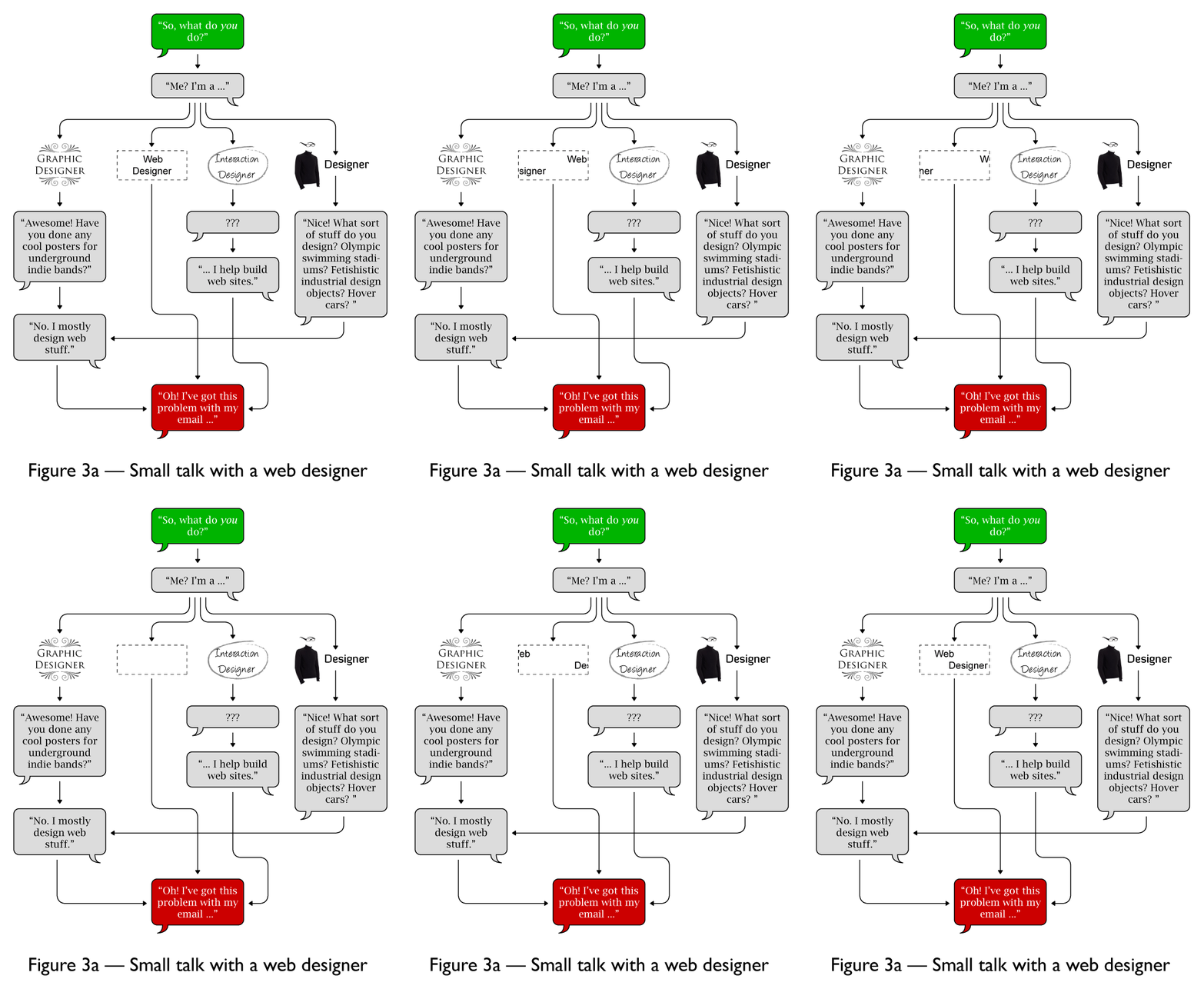
What do you do?

I found this image on another blog and thought it was quite apropos. Design is so much more than web design and yet this image identified a reality I am facing in Rwanda as far as the general understanding of the capacity of design. I appreciate my studies at ECU that encourage and seek to develop "design thinking" not just design outputs.
Speaking of output, I read Zen and the Art of Motorcycle Maintenance this weekend and found myself delighted by its address of the idea of quality. What exactly is quality and how would you know if you saw it? Design constantly touches on this as one determines something they do or don't like. I am reminded of crits where someone thought a particular solution was appropriate while another person felt otherwise.
"...Structured, dualistic subject-object knowledge...isn't enough. You have to have some feeling for the quality of the work. You have to have a sense of what's good. That is what carries you forward...not just something you are born with...it's the direct result of contact with basic reality."
Basic reality? Now that's another story.
I also appreciated its discussion on rhetoric. As one who is investigating this on many levels, I was glad for a layman's lesson in novel format.
I loved this quote as well. It's simplicity moved me beyond the words it presents: Ideas rose in crowds...he felt them collide until pairs interlocked.
In completely unrelated news: I would love to get tees made for the cooperative in Gashora (as a way of profiling themselves at events and as a means of making additional money for those who may want to support their work). If anyone is remotely keen, let me know.
Click on images for larger view
25 March 2008
Lexicon strikes again
A new workforce is emerging apparently. Are we really changing the type of work people will do or are we just refashioning an updated blue hue?
11 March 2008
It was a banner day
Politics
Family
Luxury
And yes, more luxury
This one gets marks for keeping you interested to the very end.
04 March 2008
How We Understand
Here's a quote I read somewhere and recently recovered in my sketch book. It seems to summarize some of my hunches about how the message of green has the potential to remain ineffective when the persuasive takes over: